China’s levered stock market

Consider this from Gavekal’s Chen Long on the run up in China’s A-shares:

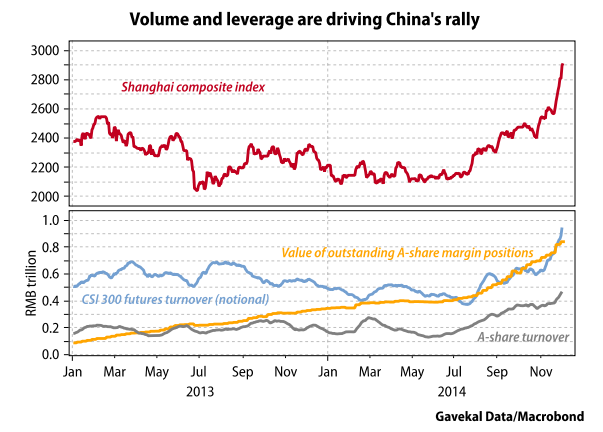
The top of the chart shows the rather dramatic spike in the Shanghai composite — up 38 per cent since the middle of the year and 15 per cent since the PBoC cut near the end of November. The bottom bit we’ll get to in a sec.

First, it’s worth noting the weirdness of the current ramp up. As Long says:

Over the last three years, the A-share market has broadly mirrored China’s economic cycle, rising when growth accelerated, and falling when growth momentum faded. Now however, A-shares are tearing higher even as China’s economic growth rate has slipped to its lowest level since the depths of the 2009 crisis.

And he’s right. China’s growth story is obviously changing (or crumbling as your viewpoint prefers) — as Pettis said in his latest blog, the current consensus seems to have dropped to between 6 per cent and 7 per cent on average, and even if you find that optimistic or the numbers meaningless the direction is clear. The PBoC etc may have been forced into a cut sooner than expected but it’s unclear how far they can push on that string, China’s ability to stimulate via credit ain’t what it used to be and even if they could repeat the 2009 and 2012-13 experiences they probably wouldn’t want to.

There’s also the fact, as Gavekal note, that the A-share rally has been led by China’s banks, which looked undeniably cheap five months ago. In July A-shares were trading at an 11 per cent discount to Hong Kong-listed H-shares. However, the intervening run-up has eliminated that valuation advantage, and today A-shares are trading at a steep 12 per cent premium versus their H-share counterparts. Less pretty, in short.

So we come to the bottom bit of that chart above and the suggestion form Long that a large chunk of this is down to leverage and momentum which has been maintained post the Shanghai Hong Kong Stock Connect ramp up.

How far Connect optimism is justified we’ll leave to later as, no matter your longer term take on that, the fact is this pretty crazy surge in A-shares happened after the PBoC cut and valuations have surged to the extent that, from a starting point of a 10 per cent discount to HK shares before the Connect, A shares have jumped to a 15 per cent premium over the past two weeks. Go figure. So, even if the opening up of Chinese shares will be a big deal (inflows, outflows will obvs increase and there are just a few risks knocking about) you still have to raise an eyebrow at the speed of the move over the past short while.

From Long for the last time to close (with our emphasis):

Over the last two years regulators have eased restrictions on China’s brokerage companies, allowing them much greater freedom to extend margin financing to retail investors. Once the market began rising, leverage soared. Since July the value of outstanding margin positions in A-shares has doubled to more than RMB800bn. Meanwhile the daily turnover of CSI 300 index futures has rocketed from RMB500bn to top RMB2trn on Wednesday, easily eclipsing turnover in S&P 500 futures.

For now this momentum looks unstoppable. But because the market is being driven by leverage, at some point it is likely to reverse abruptly and fall steeply. Several factors could trigger such a reversal. Sooner or later brokers will run up against the constraints on leverage imposed by their own capital positions. Once they can no longer expand margin lending to investors, the rally will run out of steam. Secondly, China’s fundamentals are still discouraging. Nine months ago everyone was worried about shadow banking defaults and rising bad loans. The risks have not vanished. As growth slows, defaults could rise. Finally, earnings growth is deteriorating. Non-financial SOE profit growth fell to 2% in 3Q 2014 and bank profit growth declined to 7%, the lowest in 5 years. Fourth quarter earnings are likely to be even worse. In short, the current surge in Ashares has little to do with fundamentals. When the tide recedes, the backwash is likely to be vicious.